

In today's fast changing and innovating industrial environment, ensuring the reliability, availability and efficiency of (critical) assets is essential for staying competitive. Traditional maintenance strategies based on fixed time or running hour intervals are no longer sufficient under these conditions.
Smart Maintenance Strategy
Key enabler for reliable and cost-effective maritime operations
The various stakeholders involved with the vessel seek certainty: can the ship operate, is it available for a next voyage, and what are the financial risks? For shareholders, financial guarantees are especially important. From a technical perspective, differtent questions arise, such as whether it is possible, for example, to postpone a top-end overhaul of an engine. These are just a few examples of issues that may be raised.
The key question then becomes: how wil answers be provided to all these questions, and how will those answers be substantiated?
Smart maintenance, integration condition monitoring, data analytics and decision support - offers a structurered response. This article explains what smart maintenance entails, how it supports business objectives, and which organisational factors determine successful implementation.
What is smart maintenance
Smart maintenance is an integrated maintenance strategy in which maintenance decisions are taken based on data, supported by risk assessment, operational context and organisational alignment. Its purpose is to predict potential failures, prevent failures, and optimise reliability, uptime and cost across the asset life cycle.
In smart maintenance strategy, maintenance is no longer planned according to fixed intervals or generic rules. Instead, risk-driven maintenance decisions are made using up-to-date information on the actual condition of the asset and its operating context, such as ship type, operational profile, location, crew experience and environmental conditions. With this, smart maintenance supports better decision making, as technicians receive accurate insights on asset performance and recommended actions. In essence, smart maintenance transforms traditional maintenance processes into proactive, intelligent systems that help companies achieve higher reliability and productivity.
Why now?
The timing for smart maintenance is driven by several converging developments. Technological progress in sensors (Internet of Things, IoT), connectivity and data analytics has accelerated rapidly, making high-quality operational and condition data widely available on board ships. At the same time, data connectivity between ship and shore has improved significantly. Modern satellite communication systems provide near-global coverage with sufficient bandwidth to transmit operational and maintenance data reliably and continuously.
Simultaneously, other industries such as aviation, energy and manyfacturing have already gained extensive experience with data-driven and risk based maintenance approaches, providing proven concepts and lessons learned. In parallel, maritime professionals are increasingly accustomed to digital tools and data-supported working methods. Together, these developments create the conditions for smart maintenance to be implemented effectively and at scale in the maritime sector.
Linking smart maintenance to business objectives
Traditional maintenance concepts are largely based on original equipment manufacturer (OEM) recommendations, class rules, law and regulations, and client rules, typically incorporating substantial safety margings and assuming standard operating conditions, While robust, these approached rely on uniform operating profiles and generic degradation behaviour. In practice, they insufficiently account for environmental influences, actual load profiles, operating patterns, crew behaviour and mission-specific use of the asset.
By managing a cost-effective maintenance strategy from a total cost of ownership (TCO) perspective, maintenance is no longer treated as a short-term cost item, but as an investment in a reliable and cost-efficient vessel that can fulfil its operational commitments with minimal risks. This implies that design choices, system configurations, maintenance strategies and operational planning must be considered in an integrated manner. For shipowners, the primary business objectives are macimum vessel availability, minimal operational costs, and a high level of safety and reliability (essentially limiting the risks of unexpected downtime as wel as safety and environmental incidents).
Achieving these objectives is challenging, as the increasing complexity of ship systems, hight variable operating conditions and differing organisational interests make it difficult to consistently determine and justifythe most appropriate maintenace decisions.
To implement smart maintenance successfully, as structured framework is essential. Asset management, as defined in ISO 55000, provides the structure by making explicit how technical performance, costs, risks and business objectives are interconnected. This integrated approach clarifies which assets are critical to operations and where the highest risks are concentrated. The result is a well-founded set of maintenance and investment decisions that can be consistently applied across the entire fleet.
Smart maintenance framework
Smart maintenance is best understood as an integrated asset management approach rather than a standalone technical solution. It brings together risk management, data and performance management, continuous improvement, people and competencies, and sustainability within a coherent framework. The following sections describe these elements in more detail and explain how their interaction supports effective, risk-informed maintenance decision-making.
QUANTIFYING RISK ENABLES OBJECTIVE EVALUATION OF
MAINTENANCE STRATEGIES AND INVESTMENTS
Risk management
Wihtin an ISO 55000-based asset management framework, risk management is a fundamental element for informed decision-making. ISO 55000 defines risk as the effect of uncertainty on objectives. Applied to maintenance, this meand systematically identifying and assessing risks related to asset failure and degradation, considering the likelihood of failure and degredation, considering the likelihood of failyre and the consequences for business objectives. These consequences typically include safety and environmental impact, loss of availability, operational disruption and financial cost. By making these risks explicit, organisations gain transparancy into which assets are most critical to achieving their operational and strategical objectives.
Quantifying risks, by expressing consequences in financial terms, downtime, or operational impact, enables objective evaluation of maintenance strategies and investments. This supports consistent asset-related decision-making, as required by ISO 55000, and ensures alignment between technical performance, cost efficiency and risk exposure. Maintenance decisions are no longer isolated technical choices, but part of an integrated asset management system that balance performance, risk and cost., which is incorporated into the business strategy to achieve the business objectives.
A risk-driven smart maintenance approach naturally leads to prioritisation across the fleet. It becomes clear which assets require intensive monitoring or proactive intervention, where additional condition monitoring adds demonstrable value, and which components can be managed with less intensive measures without exceeding acceptable risk levels. This ensures that resources are allocated where they contribute most to value creation and risk reduction.
A practical example: The risk profile of an engine stronghly depends on its functional role and operating context. A main engine acting as a single propulsion unit on a vessel has a fundamentally different risk profile compared to the same engine type used as a generator in a redundant power configuration. In the first case, failure may immediately result in loss of propulsion and operational downtime, whereas in the second case, redundancy significantly limits the operational impact.
Similarly, spare-part and maintenance strategies differ depending on the vessel's trading area. A ship operating in remote regions faces high downtime costs and long lead times for logistics, justifying higher spare-part availability and more proactive maintenance. In contrast, a vessel operating in the Rotterdam area can rely on rapid supply chains, allowing for a leaner spare-part stratregy without materially increasing operational risk. Risk-based smart maintenance make these differences explicit and enables miantenance strategies that are tailored to actual operational risk rather than generic assumptions.
Data and performance management
A smart maintenance strategy is not a technology project, but a change programme. To achieve lasting impact, the organisation myst be equipped with the right tooling, data architecture and competencies. Everything start with data. A well-designed fleet management system (FMS) is essential to make information accessible, reliable and usable across the organisation.
Once data is available and trusted, it enables effective performance management. Key performance indicators (KPIs) and dashboards provide continuous insight into asset performance, maintenance effectiveness and deviations from expected behaviour. Typical KPIs include availability, failure rates, mean time between failures (MTBF), mean time to repair (MTTR), maintenance cost per operating hour and safety-related indicators. When these reports are reviewd regularly and explicitly linked to decision-making, data quality improves and organisational maturity increases.
Performance management, therefore, acts as a feedback mechanism within the asset management system, ensuring that maintenance decisions are based on facts rather than assumptions.
Continuous improvement
Smart maintenance requires a culture of continuous improvement. The PDCA cycle (plan-do-check-act) provides a proven structure for this. Data is structured, performance is measured, deviations are analysed, improvement actions are defined and subsequently implemented in a structured manner. By repeating this cycle, the organisation gradually improves reliability, efficiency and predictability.
This approach transforms maintenance from a reactive activity into a learning process. Failures and deviations are no longer seen as incidents in isolation, but as opportunities to improve systems, processes and decision-making.
CULTURE IS NOT A SOFT FACTOR, BUT A CRITICAL SUCCESS CONDITION
FOR SMART MAINTENANCE
People, culture and competencies
Smart maintenance demands a shift in mindset. People must learn to report in a more structured manner, interpret data critically and look at maintenance decisions through the lens of risk, value and system performance rather than individual components. This requires competencies beyond traditional maintenance skills.
Data analysis, systems thinking, risk awarness, communication skills and process optimisation become increasingly important capabilities. Organisations that invest in developing these capabilities often achieve not only improved technical performance, but also higher levels of engagement, professionalism and ownership within their teams. Culture, therefore is not a soft factor, but a critical success condition for smart maintenance.
Sustainability
The maritime sector faces a major sustainability challenge. The IMO 2023 strategy sets ambitious targets for CO2 reduction towards 2030, 2040 and 2050. By optimising maintenance based on data and fostering a culture of continuous improvement within the organisation, smart maintenance actively contributes to achieving sustainability goals.
On the one hand, it contributes to reduced fuel consumption and emissions by ensuring that installations operate efficiently, and deviations are detected early. On the other hand, predictive and risk-driven maintenance leads to less unplanned downtime, more efficient logistics (spare part management), better planning of maintenance and/or dockings and more effective use of spare parts all of which reduce environmental impact.
Smart maintenance execution
In January 2025, a Maritime Innovation Impuls Project (MIIP) was launched to investigate the technical and economic feasibility of smart maintenance for harbour tugs. The project was executed by Predict Marine, ProAnalytics and Kotug International, and was made possible with the support of the Dutch Ministry of Economic Affairs and the Dutch Maritime Network (Nederland Maritiem Land). Within this project, anomalies in lubricating oil samples were analysed and correlated with historical thruster failure dates using data analysis techniques including machine learning algorithms.
This study brings together all key elements of smart maintenance within a structured and controlled setting. The primary objective was to assess feasibility rather than to deliver a fully mature predictive maintenance solution. The analysis was therefore conducted using a limited dataset, taking into account data quality, data completeness and uncertainty. Assumptions and threshold values were chosen conservatively to avoid overestimating the predictive capability of the models.
The risk profile of the tugboats was established and served as the foundation for both the smart maintenance strategy and the definition of threshold levels for elevated risk that require further investigation. The data analytics model predicts the probability of failure, and based on the defined threshold levels, follow-up actions are triggered in the planned maintenance system (PMS). These follow-up actions determine whether corrective measures are required or whether the system can continue to operate within acceptable boundaries.
This approach strenghtens organisational processes by directing attention only to samples that exceed defined risk thresholds. As a result, stakeholders are informed in a timely manner and the workload for crew members and superintendents remains manageable, while enabling focused and effective interventions where they add most value. Although based on a limited dataset, the intitial results indicate that it is technically feasible to apply predictive maintenance concepts to this type of asset and operating context. At the same time, the current algorithm outcomes already allow for a first-order estimation of the business case, including savings on the total cost of ownership (TCO) and return on investments (ROI).
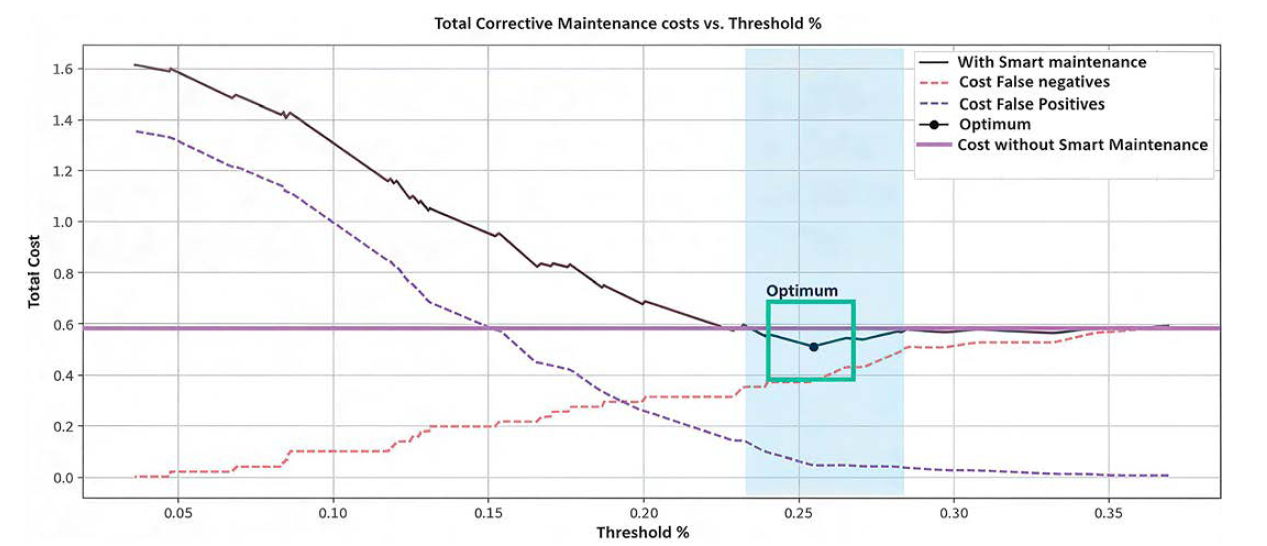
Below figure shows where the smart maintenance business case is positive based on the selected threshold percentage of the data analytics model. These findings provide sufficient justification for follow-up research and further model refinement, including expansion of the dataset, improvement of data quality and validation across a wider range of operating conditions, supporting a gradual transition from feasibility study to operational deployment.
Foundation for effective maintenance
Smart maintenance, when embedded in a well-founded and coherent framework, forms the foundation for effective and cost-efficient maintenance. By starting today, shipowners create the conditions for improved reliability, controlled risk and informed decision-making, ensuring their fleet is prepared for future operational en economic challenges.
Authors:
Marten Jan Visser, MSc | Strategic Consultant Smart Maintenance @ Predict Marine
Erik (J.H.) Klok, MSc | Co-owner and Director Innovations & Technology @ Predict Marine
Article published in SWZ|Maritime magazine March 2026 | www.swzmaritime.nl

Wondering how Predict Marine can help your organization? Contact us with no obligation!


